Bahut students yahan do mistakes karte hain. Pehli yeh ki theory padhte hain, numericals skip karte hain. Doosri yeh ki formula yaad karte hain, lekin unit galat likhte hain.
UP Board Class 10 Science Electricity ek aisa chapter hai jahan agar numericals ki practice ho gayi toh 25 se 30 marks bilkul solid aate hain। Lekin bina practice ke theory bhi kaam nahi aati.
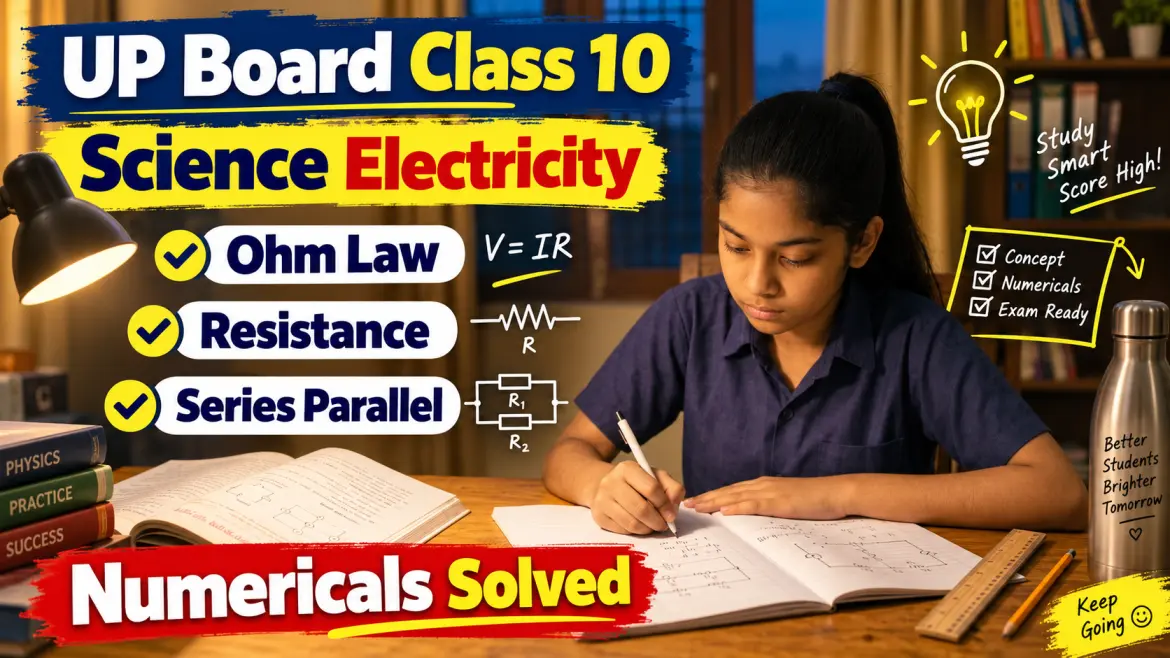
Is post mein sab kuch hai। Basic concepts, Ohm’s Law clearly, resistance ke factors, series aur parallel circuits ke step-by-step solved numericals, heating effect, electric power – sab। Exam ke practical tips alag se.
UP Board Class 10 Science Electricity: Chapter Ka Overview Pehle
Chapter mein yeh sab cover hota hai:
Pehla topic hai electric current aur potential difference ki definition aur units. Doosra hai Ohm’s Law – V equals IR. Teesra hai resistance aur resistivity, aur resistance ko affect karne wale factors. Chautha hai series aur parallel circuits mein equivalent resistance nikalna. Paanchva hai heating effect of electric current, yaani Joule’s Law. Chhatva hai electric power aur energy ke formulas.
Exam mein in sab se combined 25 to 30 marks aa sakte hain। Numericals 3 to 5 marks each ke hote hain.
UP Board Class 10 Science Electricity: Electric Current Kya Hai
Electric Current: Kisi conductor mein charge ke flow ko electric current kehte hain.
Current (I) equals Charge (Q) divided by Time (t)
I = Q/t
Unit: Ampere (A)
1 Ampere = 1 Coulomb per second
Conventional direction: Current conventional roop mein positive terminal se negative terminal ki taraf flow karta hai. Lekin actually electrons negative terminal se positive ki taraf move karte hain.
Ammeter: Current measure karta hai. Hamesha series mein connect hota hai.
UP Board Class 10 Science Electricity: Potential Difference Samjho
Potential Difference (Voltage): Do points ke beech charge ko move karne mein jo kaam hota hai, use potential difference kehte hain।
V = W divided by Q (W = work done, Q = charge)
Unit: Volt (V)
1 Volt = 1 Joule per Coulomb
Potential difference woh “push” hai jo charges ko move karti hai. Jaise paani higher level se lower level ki taraf behta hai, charge higher potential se lower potential ki taraf move karta hai.
Voltmeter: Potential difference measure karta hai. Hamesha parallel mein connect hota hai.
UP Board Class 10 Science Electricity: Ohm’s Law Ki Poori Explanation
Ohm’s Law kya kehta hai:
Constant temperature par, kisi conductor mein current (I) potential difference (V) ke directly proportional hota hai.
V is proportional to I
V = IR
Jahan R constant hai – isko Resistance kehte hain.
UP Board Class 10 Science Electricity Ohm’s Law: Formula Aur Units
Formula: V = IR
Variations:
I = V divided by R
R = V divided by I
Units:
V = Volt (V)
I = Ampere (A)
R = Ohm (Ω)
Graph: Agar V versus I ka graph banao, straight line aati hai origin se. Yahi Ohm’s Law ka graphical representation hai. Slope = R.
Ohmic aur Non-Ohmic Conductors:
Ohmic conductors, Ohm’s Law follow karte hain – constant temperature par R constant rehta hai। Jaise nichrome wire.
Non-Ohmic conductors Ohm’s Law follow nahi karte। Jaise diode, LED.
UP Board Class 10 Science Electricity: Ohm’s Law Se Numericals Step by Step
Numerical 1: Ek resistor mein 2.5 mA current hai jab 12 V potential difference apply kiya jaaye. Resistance nikalo.
Given:
V = 12 V
I = 2.5 mA = 2.5 into 10 to the power minus 3 A
Using Ohm’s Law:
R = V divided by I
R = 12 divided by (2.5 into 10 to the power minus 3)
R = 12 divided by 0.0025
R = 4800 Ω
R = 4.8 kΩ
Answer: Resistance = 4.8 kΩ
Numerical 2: Ek circuit mein 6 V battery hai aur total resistance 12 Ω hai. Current kitna hoga?
Given:
V = 6 V
R = 12 Ω
I = V divided by R
I = 6 divided by 12
I = 0.5 A
Answer: Current = 0.5 A
Numerical 3: Ek wire mein 3 A current flow karta hai jab 15 V apply hoti hai. Agar voltage 9 V kar di jaaye toh current kitna hoga?
Pehle R nikalo:
R = V divided by I = 15 divided by 3 = 5 Ω
Ab naye voltage ke liye:
I = V divided by R = 9 divided by 5 = 1.8 A
Answer: Current = 1.8 A
UP Board Class 10 Science Electricity: Resistance Kya Hai Aur Kyun Hoti Hai
Resistance woh property hai jo current ke flow ka opposition karti hai.
Unit: Ohm (Ω)
Jab electrons conductor mein move karte hain, woh atoms se collide karte hain. Yeh collisions current flow ko slow karti hain. Isi ko resistance kehte hain.
Resistivity:
Resistance sirf ek specific conductor ka property hai. Resistivity woh material property hai jo batata hai ki koi material kitna resist karta hai.
R = rho times L divided by A
Jahan:
rho = resistivity (Ω m)
L = length (m)
A = cross-sectional area (m²)
UP Board Class 10 Science Electricity Mein Resistance Ko Affect Karne Wale Factors
Factor 1: Length (Lambai)
R is proportional to L – a longer wire has more resistance.
Agar length double karo → resistance double ho jaata hai.
Intuition: Zyada atoms = zyada collisions = zyada resistance.
Factor 2: Cross-Sectional Area
R is inversely proportional to A – a thicker wire has less resistance.
Area double karo → resistance half ho jaata hai.
Intuition: Zyada space = electrons easily pass karte hain.
Factor 3: Material (Resistivity)
Different materials ki resistivity alag hoti hai
Silver ki resistivity sabse kam hai (best conductor).
Tungsten ki resistivity zyada hai (isliye bulb filament tungsten ka hota hai).
Nichrome ki resistivity aur bhi zyada hoti hai – heater elements mein use hota hai.
Factor 4: Temperature
Metals mein – temperature badhne se resistance badhta hai.
Semiconductors mein – temperature badhne se resistance ghatta hai.
Numerical 4: Ek wire ki length 1 m aur area 1 square millimetre hai। Resistivity 1.6 into 10 to the power minus 8 Ω m hai। Resistance nikalo।
Given:
L = 1 m
A = 1 mm² = 1 into 10 to the power minus 6 m²
rho = 1.6 into 10 to the power minus 8 Ω m
R = rho times L divided by A
R = (1.6 into 10 to the power minus 8 times 1) divided by (1 into 10 to the power minus 6)
R = 1.6 into 10 to the power minus 8 divided by 10 to the power minus 6
R = 1.6 into 10 to the power minus 2
R = 0.016 Ω
Answer: Resistance = 0.016 Ω
UP Board Class 10 Science Electricity: Series Circuit Samjho Aur Numericals Solve Karo
Series Circuit kya hai:
Jab resistors ek ke baad ek connected hon – ek hi path ho current ke liye।
Key Properties:
1. Same current teeno resistors mein se flow karta hai.
2. Voltage divide hoti hai: V total = V1 plus V2 plus V3
3. Equivalent resistance: R total = R1 plus R2 plus R3
Ek aasaan yaad karne ka tarika: Series mein sab ADD hota hai.
UP Board Class 10 Science Electricity Series Circuit: Solved Numericals
Numerical 5: 5 Ω, 8 Ω aur 12 Ω resistors series mein connected hain। Battery 6 V ki hai। Nikalo:
(a) Equivalent resistance
(b) Circuit mein current
(c) 12 Ω par voltage
Given:
R1 = 5 Ω, R2 = 8 Ω, R3 = 12 Ω
V = 6 V
(a) Equivalent Resistance:
R total = 5 plus 8 plus 12 = 25 Ω
(b) Current:
I = V divided by R total
I = 6 divided by 25
I = 0.24 A
(c) Voltage across 12 Ω:
V3 = I * R3
V3 = 0.24 * 12
V3 = 2.88 V
Answers: R = 25 Ω, I = 0.24 A, V3 = 2.88 V
Numerical 6: 9 V battery mein series mein 0.2 Ω, 0.3 Ω, 0.4 Ω, 0.5 Ω aur 12 Ω connected hain। 12 Ω mein se current nikalo।
Given:
V = 9 V
Resistors: 0.2, 0.3, 0.4, 0.5, 12 Ω, all in series
R total = 0.2 + 0.3 + 0.4 + 0.5 + 12
R total = 13.4 Ω
Series circuit mein same current sab mein:
I = V / R
I = 9 / 13.4
I = 0.671 A
Answer: Current through 12 Ω = 0.671 A
Yeh Posts Bhi Zaroor Padho
Science ke saath in important posts mein bhi detailed solutions hain:
1. UP Board Class 10 Science Chapter 1 Chemical Reactions: Types Balance Solved
Combination decomposition displacement types aur balancing equations step by step।2. UP Board Class 10 Maths Trigonometry: Sin Cos Tan Table Memory Tricks Identities
Trigonometry values table, memory tricks, identities aur proof likhne ka tarika।3. UP Board Class 10 Hindi Samas: 6 Types Examples Memory Tricks
Avyayibhav Tatpurush Karmadharaya Dvigu Dvandva Bahuvrihi complete guide।4. UP Board Class 10 Maths Chapter 3 Linear Equations: Substitution Elimination Solved
Dono algebraic methods word problems ke saath complete।
UP Board Class 10 Science Electricity: Parallel Circuit Samjho Aur Solve Karo
Parallel Circuit kya hai:
Jab resistors alag-alag paths par connected hon, current ko multiple routes milte hain ।
Key Properties:
Pehla – Same voltage teeno ke across hoti hai।
Doosra – Current divide hoti hai: I total = I1 plus I2 plus I3
Teesra – Equivalent resistance: 1 divided by R total = 1/R1 plus 1/R2 plus 1/R3
Equivalent resistance hamesha smallest resistance se bhi choti hoti hai parallel mein।
UP Board Class 10 Science Electricity Parallel Circuit: Important Property Aur Numericals
Kyun ghar mein parallel wiring use hoti hai:
Pehli wajah – Har appliance same voltage (220 V) receive karta hai।
Doosri wajah – Ek appliance band karo, baaki chal te rahenge।
Teesri wajah – Zyada appliances add kar sakte hain bina existing ones affect kiye।
Chauthi wajah – Agar ek mein koi fault aaye – sirf uska fuse blow hoga।
Numerical 7: Do resistors 4 Ω aur 6 Ω parallel mein connected hain। Equivalent resistance nikalo।
1/R total = 1/4 plus 1/6
LCM of 4 and 6 is 12।
1/R total = 3/12 plus 2/12 = 5/12
R total = 12/5 = 2.4 Ω
Answer: R = 2.4 Ω
Note: 2.4 Ω both 4 Ω aur 6 Ω se chota hai – yeh confirm karta hai answer sahi hai।
Numerical 8: 1 Ω aur 10 to the power 6 Ω parallel mein hain। Equivalent resistance nikalo।
1/R = 1/1 plus 1/1000000
1/R = 1 plus 0.000001 = 1.000001
R = 1/1.000001 is approximately 1 Ω
Answer: Equivalent resistance approximately 1 Ω
Lesson: Parallel mein bahut bada resistance bhi agar ek chota resistance ho toh barely effect karta hai।
Numerical 9: Parallel circuit mein teen resistors hain: 2 Ω, 3 Ω aur 6 Ω। 12 V battery connected hai। Total current aur har branch ka current nikalo।
Pehle equivalent resistance:
1/R = 1/2 plus 1/3 plus 1/6
LCM is 6।
1/R = 3/6 plus 2/6 plus 1/6 = 6/6 = 1
R = 1 Ω
Total current:
I = V/R = 12/1 = 12 A
Individual branch currents (parallel mein voltage same = 12V):
I1 = 12/2 = 6 A
I2 = 12/3 = 4 A
I3 = 12/6 = 2 A
Check: 6 plus 4 plus 2 = 12 A = Total current ✅
Answer: R = 1 Ω, I total = 12 A, I1 = 6A, I2 = 4A, I3 = 2A
Numerical 10: Kitne 176 Ω resistors parallel mein connect karein ki 220 V line par 5 A current flow kare?
Given:
V = 220 V, I = 5 A
Equivalent resistance needed:
R = V/I = 220/5 = 44 Ω
Let x resistors connected in parallel:
1/44 = x/176
x = 176/44 = 4
Answer: 4 resistors of 176 Ω each
UP Board Class 10 Science Electricity: Mixed Circuit Numericals
Numerical 11: Teen 6 Ω resistors kaise connect karein ki equivalent resistance 9 Ω aaye? Aur 4 Ω aaye?
(a) 9 Ω banane ke liye:
Do resistors parallel mein: 1/R parallel = 1/6 plus 1/6 = 2/6 → R parallel = 3 Ω
Phir is combination ko teesre ke series mein: R total = 3 plus 6 = 9 Ω ✅
(b) 4 Ω banane ke liye:
Do resistors series mein: R series = 6 plus 6 = 12 Ω
Phir is combination ko teesre ke parallel mein:
1/R total = 1/12 plus 1/6 = 1/12 plus 2/12 = 3/12 = 1/4
R total = 4 Ω ✅
Answer: (a) Two in parallel, then series with third. (b) Two in series, then parallel with third.
UP Board Class 10 Science Electricity: Heating Effect Aur Joule’s Law
Joule’s Heating Law:
Jab current kisi conductor mein flow karta hai toh heat produce hoti hai।
H = I² R t
Jahan:
H = Heat produced (Joules)
I = Current (Amperes)
R = Resistance (Ohms)
t = Time (seconds)
Practical Applications:
Electric heater, geyser, toaster, iron – yeh sab heating effect use karte hain।
Bulb ka tungsten filament bahut zyada temperature par glow karta hai kyunki uski resistivity high hai।
Numerical 12: 220 V supply se ek electric heater 0.5 kW heat produce karta hai। Current aur resistance nikalo।
P = 500 W, V = 220 V
Current:
P = VI
I = P/V = 500/220 = 2.27 A
Resistance:
R = V/I = 220/2.27 = 96.9 Ω
Ya directly: R = V²/P = 220² / 500 = 48400/500 = 96.8 Ω
Answer: I = 2.27 A, R = 96.8 Ω
UP Board Class 10 Science Electricity Mein Power Ke Formulas
Electric Power woh rate hai jis par electrical energy consume ya produce hoti hai।
Teen forms mein power:
P = VI (most basic)
P = I²R (current se)
P = V²/R (voltage se)
Unit: Watt (W)
1 Watt = 1 Joule per second
Electric Energy:
E = Pt
E = VIt
E = I²Rt
Unit: Joule (J) ya Kilowatt-hour (kWh)
1 kWh = 3.6 into 10 to the power 6 Joules = 1 Unit of electricity
Numerical 13: Ek bulb “40 W, 220 V” rated hai। Resistance nikalo aur 10 ghante mein kitni energy consume hogi?
Given: P = 40 W, V = 220 V
Resistance:
R = V²/P = 220²/40 = 48400/40 = 1210 Ω
Energy in 10 hours:
E = Pt = 40 W times (10 times 3600 s)
E = 40 times 36000 = 1440000 J = 1440 kJ
In kWh: E = 40/1000 times 10 = 0.4 kWh = 0.4 Units
Answer: R = 1210 Ω, E = 1440 kJ = 0.4 kWh
UP Board Class 10 Science Electricity: Ammeter Voltmeter Aur Fuse
Ammeter:
Current measure karta hai।
Series mein connect hota hai।
Resistance bahut kam hoti hai (ideal: zero) – taaki current measurement disturb na ho।
Voltmeter:
Potential difference measure karta hai।
Parallel mein connect hota hai।
Resistance bahut zyada hoti hai (ideal: infinite) – taaki current branch nahi ho।
Fuse Wire:
Safety device hai।
Low melting point wali wire hoti hai (tin-lead alloy)।
Excessive current se yeh melt ho jaati hai – circuit break ho jaata hai।
Rating: 5A, 15A, etc. – isse zyada current aane par fuse blow hota hai।
MCB (Miniature Circuit Breaker):
Modern fuse alternative hai। Reusable hai – trip karo aur reset karo।
UP Board Class 10 Science Electricity: Exam Ke Liye Important Tips
Yeh tips actually marks mein fark laate hain।
Tip 1: Unit hamesha likho
R = 50 likha aur Ω nahi diya – half marks cut ho sakte hain। V, A, Ω, W, J – sab units mandatory hain।
Tip 2: Given, Find, Formula, Solve, Answer format
Har numerical mein:
Given: (sab given values)
Find: (kya nikalna hai)
Formula: (kaunsa formula use kar rahe ho)
Solution: (step by step)
Answer: (final with unit)
Examiner ko scanning mein marks dene mein easy hota hai।
Tip 3: Series vs Parallel – ek quick test
Agar current same sab mein = Series
Agar voltage same sab mein = Parallel
Tip 4: Parallel mein check karo
Agar equivalent resistance smallest resistance se badi aa rahi hai – calculation galat hai।
Parallel mein equivalent hamesha chota hota hai।
Tip 5: Power ke teen forms pakke karo
P = VI, P = I²R, P = V²/R
Teen mein se jo bhi diya ho – woh use karo।
Tip 6: Joule’s Law mein time seconds mein
Minutes diye hon toh seconds mein convert karo pehle।
H = I²Rt mein t seconds mein hona chahiye।
Practice Questions: UP Board Class 10 Science Electricity
Khud solve karo – answers neeche hain।
Question 1: 6 Ω aur 12 Ω resistors pehle series mein phir parallel mein connect karo। Dono cases mein equivalent resistance nikalo।
Question 2: Ek heater 220 V par 4 A current leta hai। Power aur 2 ghante mein energy consumed nikalo।
Question 3: Ek wire ki length 2 m, area 0.5 mm², resistivity 2 into 10 to the power minus 8 Ω m। Resistance nikalo।
Question 4: V = 20 V, R = 4 Ω series circuit mein. I nikalo aur phir agar ek aur 4 Ω parallel mein lagaao toh total current kya hoga?
Question 5: Ek geyser 2 kW ka hai। Agar yeh roz 30 minutes chalao toh mahine mein (30 din) kitne units electricity consume hogi?
Answers:
Question 1:
Series: R = 6 plus 12 = 18 Ω
Parallel: 1/R = 1/6 plus 1/12 = 2/12 plus 1/12 = 3/12 = 1/4
R = 4 Ω
Question 2:
P = VI = 220 times 4 = 880 W
E = Pt = 880 times (2 times 3600) = 880 times 7200 = 6336000 J = 6336 kJ
In kWh: 0.88 kW times 2 h = 1.76 kWh = 1.76 units
Question 3:
A = 0.5 mm² = 0.5 times 10 to the power minus 6 m²
R = rho times L / A
R = (2 times 10 to the power minus 8 times 2) / (0.5 times 10 to the power minus 6)
R = (4 times 10 to the power minus 8) / (5 times 10 to the power minus 7)
R = 0.08 Ω
Question 4:
Initial: I = V/R = 20/4 = 5 A
After adding 4 Ω in parallel:
1/R parallel = 1/4 plus 1/4 = 2/4 = 1/2
R parallel = 2 Ω
New I = V/R = 20/2 = 10 A
Question 5:
Daily energy = 2 kW times 0.5 h = 1 kWh
Monthly = 1 times 30 = 30 units
FAQ: UP Board Class 10 Science Electricity
Pehla Sawaal: UP Board Class 10 Science Electricity se exam mein kitne marks aate hain?
Chapter 12 Electricity ek high-weightage chapter hai। Directly 15 to 20 marks expect karo। Numericals 5 marks tak ke hote hain aur theory questions 2 to 3 marks ke। Ek complete aur well-practiced chapter hai।
Doosra Sawaal: Series aur parallel mein fark easily kaise pehchano?
Ek hi wire hai, ek hi path hai = Series। Multiple paths hain current ke liye = Parallel। Current same sab mein = Series। Voltage same sab mein = Parallel।
Teesra Sawaal: Parallel mein equivalent resistance smallest se bhi chota kyun hota hai?
Parallel circuit mein extra paths add hone se total opposition kam hoti hai। Imagine ek road mein ek lane se paanch lanes – more lanes = less jam। Similarly more parallel resistors = less total resistance।
Chautha Sawaal: Ohm’s Law ki practical limitation kya hai?
Ohm’s Law sirf ohmic conductors par apply hoti hai at constant temperature। High temperature par resistance change ho jaati hai। Semiconductor devices, diodes – yeh Ohm’s Law follow nahi karte।
Paanchva Sawaal: Tungsten hi bulb filament mein kyun use hota hai?
Tungsten ka melting point bahut high hai (3380°C)। High resistivity hai – zyada heat aur light produce karta hai। Aur filament form mein draw kiya ja sakta hai। Yeh sab properties tungsten ko ideal banati hain।
Chhatva Sawaal: Ammeter series mein aur voltmeter parallel mein kyun?
Ammeter current measure karta hai – agar parallel lagao toh woh short circuit banega। Series mein lagane se circuit ka current hi measure hota hai। Voltmeter potential difference measure karta hai – parallel mein lagane se dono points ka voltage milta hai without disturbing the circuit।
Saatva Sawaal: kWh aur Joule mein kya sambandh hai?
1 kWh = 1 kilowatt times 1 hour = 1000 W times 3600 s = 3.6 into 10 to the power 6 Joules = 3600000 J। Electricity bills mein kWh (Unit) use hota hai kyunki Joule bahut chota unit hai practical use ke liye।
Aathva Sawaal: Fuse wire low melting point wali kyun hoti hai?
Fuse ka kaam hai excessive current aane par circuit break karna। Agar melting point high hoti toh woh jaldi nahi melta aur appliances damage ho jaate। Low melting point = jald se jald melt = protection।
Nauva Sawaal: Resistance temperature se kaise affect hota hai?
Metals mein temperature badhne se resistance badhta hai – kyunki atoms zyada vibrate karte hain aur electrons se zyada collide hote hain। Semiconductors mein ulta hota hai – temperature badhne se zyada charge carriers free hote hain aur resistance ghatta hai।
Dasva Sawaal: Ghar mein parallel wiring kyun use hoti hai series nahi?
Series mein ek bulb band karo toh sab band ho jaate hain। Parallel mein har appliance independent hai। Series mein voltage divide hoti hai – sabko 220V nahi milta। Parallel mein sab 220V receive karte hain। Isliye ghar mein parallel wiring zaroori hai।
Conclusion
UP Board Class 10 Science Electricity ek aise chapter hai jo samajhne mein logical hai – formula se numericals seedha solve hote hain।
Jo pakka karo:
Pehla – Ohm’s Law V equals IR – teen roop mein: V = IR, I = V/R, R = V/I।
Doosra – Series aur parallel ka ek rule: Series mein ADD, Parallel mein RECIPROCAL ADD।
Teesra – Power ke teen forms: P = VI, P = I²R, P = V²/R।
Chautha – Units hamesha likho: V, A, Ω, W, J, kWh।
Paanchva – Roz do numerical solve karo – speed aur accuracy dono aayengi।
Ek achhi baat yeh hai ki is chapter ke numericals straightforward formula application hain। Koi bhi formula misapply nahi karte agar step-by-step likhenge।
Aaj raat se shuru karo – Ohm’s Law ke 5 numericals practice karo। Kal series circuit ke, parso parallel ke। Ek hafte mein yeh chapter complete hoga।
Important: NCERT ki official website ncert.nic.in par Class 10 Science Chapter 12 Electricity ki free PDF available hai। Wahan sabhi in-text questions aur exercises hain। UP Board ke liye NCERT textbook hi primary reference hai – sab exercises zaroor solve karo।
Disclaimer: upboard10th.com ek independent educational website hai। Yahan di gayi explanations aur solved numericals carefully prepare ki gayi hain lekin UPMSP ki official answer key final authority hai। Kisi bhi doubt ke liye apne Science teacher se guidance zaroor lo।