
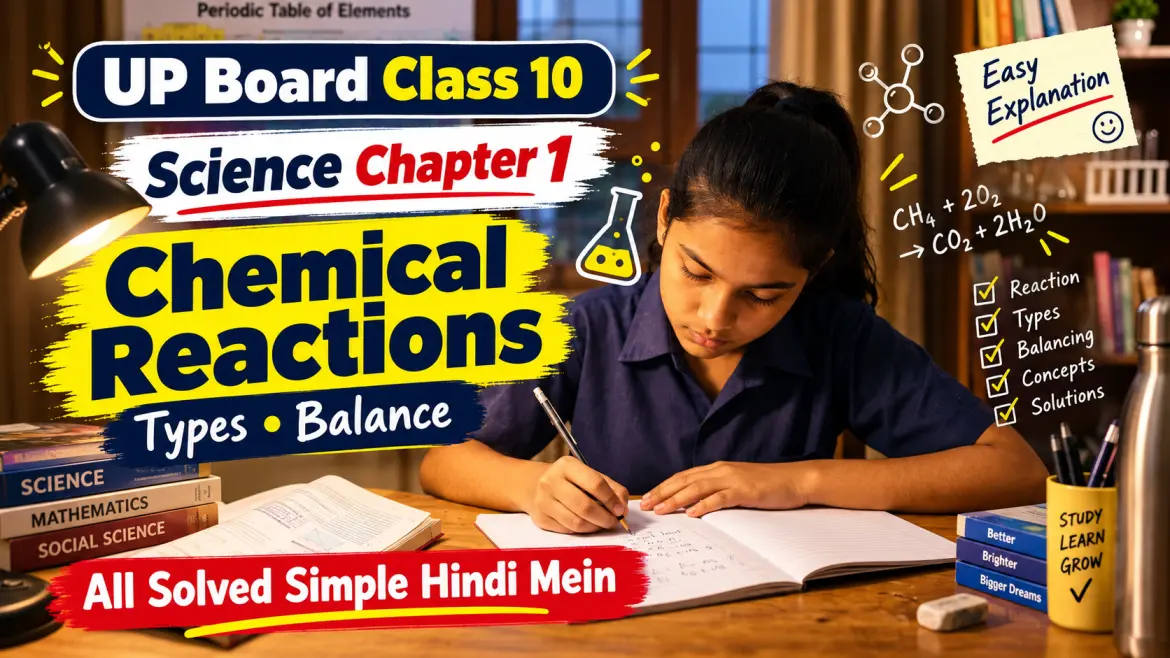
Science mein pehla chemistry chapter aata hai aur bahut students ke pet mein halki si nervousness aati hai.
“Chemical Reactions and Equations” padh ke lagta hai yeh complex hai. Equations hain, balancing hai, types hain, aur phir corrosion aur rancidity jaise terms hain.
Lekin honestly, UP Board Class 10 Science Chapter 1 Chemical Reactions actually ek practical chapter hai. Yeh sab woh cheezein hain jo aap roz dekhtey ho – lohe par zang lagna, milk ka curdle hona, khana pakna, kagaz jalana – sab chemical reactions hain.
Is post mein poora chapter zero se cover karenge. Equations kaise likhni hain, kaise balance karni hain, types kya hain, aur exam mein exactly kya likhna chahiye – sab kuch step by step.
Ek stat jo helpful lagti hai – 71% Class 10 students ne bataya ki balancing chemical equations is chapter ka sabse mushkil part hai, aur 3 out of 5 students board exam mein state symbols jaise (s), (l), (g) aur (aq) bhoolne ki wajah se marks gavaate hain.
UP Board Class 10 Science Chapter 1 Chemical Reactions: Pehle Chapter Ka Map Dekho
Chapter mein kya kya hai:
Pehla topic hai chemical reaction kya hai aur kaise pehchante hain. Doosra hai chemical equations kaise likhte aur balance karte hain. Teesra aur sabse zyada marks wala topic hai reaction ke types. Chautha hai oxidation aur reduction. Paanchva hai daily life mein oxidation ke effects, yaani corrosion aur rancidity.
Exam mein in sab se milke 25 se 30 marks aa sakte hain. Balancing questions aur definition questions is chapter mein sabse zyada marks ke hote hain.
Chemical Reaction Kya Hai: UP Board Class 10 Science Chapter 1 Ki Shuruat
Seedha example se shuru karte hain।
Ek lohey ki keel sochon। Kuch din baahar chhodi – uske upar zang aaya. Lohe ka rang aur texture dono change ho gaye. Naya substance ban gaya – iron oxide.
Definition: Chemical reaction woh process hai jisme ek ya zyada substances (reactants) aapas mein react karke bilkul nayi properties wale substances (products) banate hain.
Important point yeh hai ki nayi substance banati hai. Agar sirf shape ya size change hua – woh physical change hai. Jaise ice ka pani banana physical change hai – dono mein H2O hi hai, sirf state change hui.
Lekin magnesium ko jalao – MgO bana. Yeh alag substance hai. Yeh chemical change hai.
Kaise Pehchano Ki Chemical Reaction Hua: UP Board Class 10 Science Chapter 1 Mein Signs
Yeh signs dekho – inme se koi bhi ek dikh jaaye toh chemical reaction hua:
1. Rang Badalna
Magnesium ka dhaaga chalaki hai, jalane ke baad safed powder (MgO) ban jaata hai. Iron ka keel rang badal kar laal-bhura ho jaata hai.
2. Gas Banna
Zinc ko sulphuric acid mein daalo – bubbles aate hain. Woh hydrogen gas hai। Reaction hua.
3. Temperature Change
CaO (quicklime) ko paani mein daalo – bahut heat aati hai. Yeh exothermic reaction hai. Kuch reactions mein heat absorb hoti hai – woh endothermic.
4. Precipitate Banna
Barium chloride aur sodium sulphate solution milao – safed solid precipitate banta hai. Yeh product hai.
5. State Change
Wax jalti hai – solid se liquid, phir gas. Combustion reaction.
Chemical Equation Likhna Aur Balance Karna: UP Board Class 10 Science Chapter 1
Chemical Equation Kaise Likhte Hain: UP Board Class 10 Science Chapter 1 Ka Foundation
Chemical equation ek shorthand notation hai jo reaction ko symbols aur formulae se represent karta hai.
Structure:
Reactants se arrow (→) ke baad Products
Jaise: Magnesium jalana – Magnesium aur Oxygen react karke Magnesium Oxide banta hai.
Pehle word equation:
Magnesium plus Oxygen → Magnesium Oxide
Phir symbolic equation:
Mg plus O2 → MgO
State Symbols – Yahaan 3/5 students galti karte hain:
(s) matlab solid, (l) matlab liquid, (g) matlab gas, (aq) matlab aqueous yaani paani mein ghola hua.
Complete equation with state symbols:
2Mg(s) plus O2(g) → 2MgO(s)
UP Board Class 10 Science Chapter 1 Chemical Reactions: Equation Balance Karne Ka Method
Yahan 71% students struggle karte hain। Isko clearly samjho.
Kyun balance karte hain?
Law of Conservation of Mass kehta hai ki chemical reaction mein total mass constant rehta hai। Atoms nahi bante, nahi toot-te – sirf rearrange hote hain। Isliye dono sides mein atoms ki sankhya same honi chahiye।
Step-by-step method – Hit and Trial (most common):
1. Skeletal equation likho.
2. Har element ke atoms dono sides mein gino.
3. Jis element ke atoms unequal hain, uska coefficient badlo.
4. Dobara gino। Sab balance hua ya nahi.
5. State symbols add karo.
Yeh rule yaad rakho: Sirf coefficients change karte hain, formulae nahi. H2O ko H3O nahi likh sakte.
UP Board Class 10 Science Chapter 1: Balancing Solved Example 1
Question: Hydrogen aur Chlorine react karke Hydrogen Chloride banate hain. Balance karo.
Skeletal: H2 plus Cl2 → HCl
Left side: H = 2, Cl = 2
Right side: H = 1, Cl = 1
HCl ke aage coefficient 2 lagao:
H2 plus Cl2 → 2HCl
Left: H = 2, Cl = 2
Right: H = 2, Cl = 2
Balanced: H2(g) plus Cl2(g) → 2HCl(g)
UP Board Class 10 Science Chapter 1: Balancing Solved Example 2 (Thoda Mushkil)
Question: Iron aur water react karke Ferric oxide aur Hydrogen banate hain.
Skeletal: Fe plus H2O → Fe2O3 plus H2
Left: Fe = 1, H = 2, O = 1
Right: Fe = 2, H = 2, O = 3
Fe balance karo – left mein Fe ko 2 karo: 2Fe
O balance karo – left mein H2O ko 3 karo: 3H2O
H balance karo – right mein H2 ko 3 karo: 3H2
Check: 2Fe plus 3H2O → Fe2O3 plus 3H2
Left: Fe = 2, H = 6, O = 3
Right: Fe = 2, O = 3, H = 6
Balanced: 2Fe(s) plus 3H2O(l) → Fe2O3(s) plus 3H2(g)
UP Board Class 10 Science Chapter 1: Balancing Solved Example 3 (Important Wala)
Question: Barium chloride aur Sodium sulphate react karte hain.
Skeletal: BaCl2 plus Na2SO4 → BaSO4 plus NaCl
Left: Ba = 1, Cl = 2, Na = 2, S = 1, O = 4
Right: Ba = 1, S = 1, O = 4, Na = 1, Cl = 1
Na aur Cl balance karo – right mein NaCl ko 2 karo:
BaCl2 plus Na2SO4 → BaSO4 plus 2NaCl
Left: Ba = 1, Cl = 2, Na = 2, S = 1, O = 4
Right: Ba = 1, S = 1, O = 4, Na = 2, Cl = 2
Balanced: BaCl2(aq) plus Na2SO4(aq) → BaSO4(s) plus 2NaCl(aq)
UP Board Class 10 Science Chapter 1 Chemical Reactions: Types Kya Hain
Yeh is chapter ka heart hai. Toppers ne bataya ki reaction type ka naam pehle likhne se 3-mark questions mein 1 se 2 extra marks milte hain.
Paanch main types hain – combination, decomposition, displacement, double displacement, aur redox.
Combination Reaction: UP Board Class 10 Science Chapter 1 Ka Pehla Type
Definition: Do ya zyada substances combine karke ek naya substance banate hain.
General form: A plus B → AB
Examples:
Example 1: Hydrogen aur Oxygen react karke Water bana.
2H2(g) plus O2(g) → 2H2O(l)
Example 2: CaO (Quicklime) aur water react karke slaked lime bana.
CaO(s) plus H2O(l) → Ca(OH)2(aq)
Yeh exothermic reaction bhi hai – bahut heat nikalta hai.
Example 3: Magnesium jalana
2Mg(s) plus O2(g) → 2MgO(s)
Exam tip: Jab bhi equation mein do cheezein ek mein merge ho rahi hain – combination reaction hai
Decomposition Reaction: UP Board Class 10 Science Chapter 1 Chemical Reactions Ka Doosra Type
Definition: Ek substance toot ke do ya zyada substances banata hai
General form: AB → A + B
Yeh combination ka opposite hai
Types of Decomposition:
Thermal Decomposition – Heat se hoti hai:
Calcium carbonate garam karne par:
CaCO3(s) → CaO(s) + CO2(g)
Yeh cement industry mein use hota hai
Electrolytic Decomposition – Electric current se:
Water mein current daalo:
2H2O(l) → 2H2(g) + O2(g)
Hydrogen cathode par, Oxygen anode par collect hota hai।
Photodecomposition – Light se:
Silver chloride ki light mein:
2AgCl(s) → 2Ag(s) + Cl2(g)
Isliye photography mein AgCl use hoti thi।
Silver bromide bhi isi tarah:
2AgBr(s) → 2Ag(s) + Br2(g)
Exam tip: Decomposition mein heat, light ya electricity – koi energy chahiye hoti hai। Yeh remember karo.
Displacement Reaction: UP Board Class 10 Science Chapter 1 Chemical Reactions Ka Teesra Type
Definition: Ek zyada reactive element doosre less reactive element ko uske compound se bahar nikaalta hai.
General form: A + BC → AC + B
Examples:
Iron aur copper sulphate solution:
Fe(s) + CuSO4(aq) → FeSO4(aq) + Cu(s)
Yahan iron zyada reactive hai copper se. Iron ne copper ko displace kar diya. Solution ka rang blue se light green ho gaya. Copper metal bahar aa gayi.
Zinc aur copper sulphate:
Zn(s) + CuSO4(aq) → ZnSO4(aq) + Cu(s)
Zinc aur Sulphuric acid:
Zn(s) + H2SO4(aq) → ZnSO4(aq) + H2(g)
Reactivity Series yaad rakho: K > Na > Ca > Mg > Al > Zn > Fe > Ni > Sn > Pb > H > Cu > Ag > Au
Double Displacement Reaction: UP Board Class 10 Science Chapter 1 Ka Chautha Type
Definition: Do compounds ke ions interchange karte hain – do displacements ek saath.
General form: AB + CD → AD + CB
Ions swap karte hain.
Examples:
Sodium sulphate aur Barium chloride:
Na2SO4(aq) + BaCl2(aq) → BaSO4(s) + 2NaCl(aq)
BaSO4 ka white precipitate banta hai
Sodium hydroxide aur Hydrochloric acid (neutralisation):
NaOH(aq) + HCl(aq) → NaCl(aq) + H2O(l)
Acid-base neutralisation bhi double displacement hai.
Silver nitrate aur Sodium chloride:
AgNO3(aq) + NaCl(aq) → AgCl(s) + NaNO3(aq)
AgCl ka white precipitate – yeh test hai Cl- ions ke liye।
Precipitate kya hota hai: Reaction mein jo insoluble solid banta hai, woh precipitate hai।
Yeh Posts Bhi Zaroor Padho
Science ke saath saath yeh important posts bhi check karo:
1. UP Board Class 10 Maths Chapter 1 Real Numbers: HCF LCM Euclid Division Solved
Euclid algorithm se HCF, prime factorization se LCM aur irrational numbers proof step by step solved।2. UP Board Class 10 Maths Chapter 3 Linear Equations: Substitution Elimination Solved
Substitution aur elimination methods solved examples ke saath, word problems aur exam tips।3. UP Scholarship Dashmottar 2026-27: ITI BA BTech Apply Guide October 31
College students ke liye scholarship guide. October 31 last date, documents aur OTR process।4. UP Board 10th Compartment Exam 2026: Complete Guide
Compartment form, fees, dates aur exam day tips poori jankari।
Oxidation Aur Reduction: UP Board Class 10 Science Chapter 1 Chemical Reactions
Yeh concept bahut students ko confuse karta hai। Seedha samjhate hain.
Oxidation kab hota hai: Jab oxygen gain ho ya hydrogen lose ho ya electrons lose hon.
Reduction kab hota hai: Jab oxygen lose ho ya hydrogen gain ho ya electrons gain hon.
Important rule: Oxidation aur Reduction hamesha saath hote hain. Jab ek substance oxidise hota hai toh doosra reduce hota hai। Isliye inhe Redox Reactions kehte hain.
Example 1: Copper aur Oxygen
2Cu(s) + O2(g) → 2CuO(s)
Copper ne oxygen gain kiya – copper oxidised hua।
Example 2: CuO aur Hydrogen
CuO(s) + H2(g) → Cu(s) + H2O(l)
CuO ka oxygen gaya (oxygen lost) – CuO reduced hua।
H2 ne oxygen gain kiya – H2 oxidised hua।
Example 3: ZnO aur Carbon
ZnO(s) + C(s) → Zn(s) + CO(g)
ZnO: Oxygen lost → Reduced. C: Oxygen gained → Oxidised.
Oxidising Agent vs Reducing Agent:
Oxidising agent woh hai jo doosre ko oxidise karta hai, khud reduce hokar.
Reducing agent woh hai jo doosre ko reduce karta hai, khud oxidise hokar.
Upar example mein: C reducing agent hai, ZnO oxidising agent
UP Board Class 10 Science Chapter 1 Chemical Reactions: Corrosion Aur Rancidity
Yeh daily life section hai. Yahan se definition aur prevention wale questions zaroor aate hain.
Corrosion Kya Hai: UP Board Class 10 Science Chapter 1 Mein
Metals ka dhire dhire react karna moisture, air ya chemicals ke saath – yahi corrosion hai।
Sabse common example iron ka rusting hai।
Rusting of iron ko represent karte hain: 4Fe + 3O2 → 2Fe2O3
Yah laal-bhura iron oxide hai – zang
Silver ka tarnishing, copper ka green patina banana – sab corrosion ke examples hain।
Corrosion se kya nuksan hai:
Bridges, ships, buildings – iron structures weak ho jaate hain। Billions of rupees ka nuksan hota hai har saal।
Corrosion rokne ke tarike:
Pehla tarika hai painting – iron surface pe paint karo, oxygen aur moisture nahi pahunchega.
Doosra tarika hai oiling and greasing – machines mein use hota hai.
Teesra tarika hai galvanisation – iron pe zinc ki layer chadhaao. Zinc iron se zyada reactive hai, toh zinc pehle react karta hai, iron safe rehta hai.
Chautha tarika hai alloying – iron mein carbon, chromium etc. milao; stainless steel mein chromium hai, isliye zang nahi lagta.
Paanchva tarika hai tin plating – tin cans mein iron pe tin coat hota hai.
Rancidity Kya Hai: UP Board Class 10 Science Chapter 1 Chemical Reactions Mein
Oils aur fats ka oxidation hone se unki smell aur taste kharab ho jaate hain – yahi rancidity hai.
Example: Purana ghee ya butter khao toh kadwa ya kharab lage. Yeh rancid ho gaya.
Chemical basis: Unsaturated fats mein double bonds hote hain jo oxygen ke saath react karte hain. Aldehydes aur carboxylic acids bante hain jo kharab smell dete hain.
Rancidity rokne ke tarike:
1. Antioxidants add karo – BHA, BHT jaise chemicals rancidity rokne wale hain. Chips ke packets mein yahi hota hai.
2. Nitrogen gas mein seal karo – chips ke packets mein nitrogen hoti hai, isliye oxygen nahi pahunchti.
3. Refrigerator mein rakhna – cold temperature mein oxidation slow hoti hai.
4. Airtight containers – oxygen se door rakhna.
Exothermic Aur Endothermic Reactions: UP Board Class 10 Science Chapter 1 Ka Extra But Important Part
Exothermic Reactions: Jinmein heat release hoti hai।
CaO + H2O → Ca(OH)2 plus heat … Quicklime reaction
Combustion of LPG, burning of coal – sab exothermic hain. Yahi heating aur cooking ka basis hai।
Respiration bhi exothermic hai:
C6H12O6(aq) + 6O2(aq) → 6CO2(aq) + 6H2O(l) plus energy
Endothermic Reactions: Jinmein heat absorb hoti hai.
Thermal decomposition exothermic ka opposite hai:
CaCO3(s) → CaO(s) + CO2(g) … Heat chahiye
Photosynthesis endothermic hai:
6CO2(aq) + 6H2O(l) → C6H12O6(aq) + 6O2(g)
Energy sunlight se aati hai.
Important Balanced Equations Practice: UP Board Class 10 Science Chapter 1 Chemical Reactions
Yeh sab commonly aate hain exam mein:
Equation 1: Water banana
2H2(g) + O2(g) → 2H2O(l)
Type: Combination, Exothermic
Equation 2: Magnesium oxide banana
2Mg(s) + O2(g) → 2MgO(s)
Type: Combination, Oxidation of Mg
Equation 3: Water ka electrolysis
2H2O(l) → 2H2(g) + O2(g)
Type: Electrolytic Decomposition, Endothermic
Equation 4: Calcium carbonate ka decomposition
CaCO3(s) → CaO(s) + CO2(g)
Type: Thermal Decomposition
Equation 5: Hydrogen aur Chlorine
H2(g) + Cl2(g) → 2HCl(g)
Type: Combination
Equation 6: Iron aur Copper Sulphate
Fe(s) + CuSO4(aq) → FeSO4(aq) + Cu(s)
Type: Displacement, Redox
Equation 7: Sodium hydroxide aur Hydrochloric acid
NaOH(aq) + HCl(aq) → NaCl(aq) + H2O(l)
Type: Double Displacement, Neutralization
Equation 8: AgCl ka photo decomposition
2AgCl(s) → 2Ag(s) + Cl2(g)
Type: Photo Decomposition
Equation 9: Iron rusting
4Fe(s) + 3O2(g) → 2Fe2O3(s)
Type: Slow Combustion, Corrosion
Equation 10: Barium chloride aur Sodium sulphate
BaCl2(aq) + Na2SO4(aq) → BaSO4(s) + 2NaCl(aq)
Type: Double Displacement, Precipitation
UP Board Class 10 Science Chapter 1 Chemical Reactions: Exam Ke Liye Practical Tips
Yeh tips actually marks mein fark laate hain.
Tip 1: Reaction type hamesha pehle likho
3-mark question mein “This is a combination reaction” ya “This is a displacement reaction” pehle likho। Phir equation। Toppers ke anusar yeh ek step 1 se 2 extra marks deta hai।
Tip 2: State symbols bhoolna nahi
(s), (l), (g), (aq) – yeh zaroor likho। 3 out of 5 students yahi bhool ke marks gawaate hain। Ek symbol ke liye fraction of mark cut ho sakta hai।
Tip 3: Balancing verification karo
Equation likhne ke baad dono sides mein atoms gino। 1 minute ka kaam hai lekin wrong equation = zero marks।
Tip 4: Word equation se shuru karo aur phir symbolic
Kuch students directly symbolic likhte hain aur galti karte hain। Word equation ka step marks deta hai aur clarity bhi।
Tip 5: Diagrams helpful hain electrolysis mein
Electrolytic decomposition ka diagram banaao – cathode, anode, electrodes clearly label karo। Diagram ke marks alag hote hain।
Tip 6: Rancidity aur Corrosion ke prevention points numbered likho
Definition ke baad prevention points 1, 2, 3 numbered format mein likho। Examiner clearly dekh sakta hai।
Tip 7: Exothermic aur Endothermic identify karna
Combination reactions generally exothermic hain। Decomposition reactions generally endothermic hain। Yeh rule yaad rakho।
Practice Questions: UP Board Class 10 Science Chapter 1 Chemical Reactions
Khud try karo:
Question 1: Balance karo: Al plus O2 → Al2O3
Question 2: Displacement reaction kya hai? Ek example likho aur equation balance karo।
Question 3: Sodium aur Water ki reaction likho। Type batao।
Question 4: Double displacement aur displacement mein kya fark hai?
Question 5: Corrosion rokne ke koi tin tarike likho।
Question 6: CuO aur H2 ki reaction mein kaunsa substance oxidized hua aur kaunsa reduced?
Answers:
Question 1 ka answer:
Al plus O2 → Al2O3
Left: Al = 1, O = 2
Right: Al = 2, O = 3
Al ko 2 karo: 2Al … O ko 3/2 karo – integers mein laao, sab ko 2 se multiply:
4Al plus 3O2 → 2Al2O3
Left: Al = 4, O = 6
Right: Al = 4, O = 6. Balanced!
4Al(s) plus 3O2(g) → 2Al2O3(s)
Question 2 ka answer:
Displacement reaction mein ek zyada reactive element, doosre less reactive element ko uske salt solution se bahar nikaalata hai।
Example: Fe(s) plus CuSO4(aq) → FeSO4(aq) plus Cu(s)
Question 3 ka answer:
2Na(s) plus 2H2O(l) → 2NaOH(aq) plus H2(g)
Type: Displacement reaction (Na displaces H from water). Highly exothermic bhi hai।
Question 4 ka answer:
Displacement mein sirf ek element doosre ko replace karta hai – A plus BC → AC plus B।
Double displacement mein dono compounds ke ions exchange hote hain – AB plus CD → AD plus CB। Generally precipitate ya water banta hai।
Question 5 ka answer:
Paint karna, Galvanisation (zinc coat), Alloying (stainless steel banana)।
Question 6 ka answer:
CuO(s) plus H2(g) → Cu(s) plus H2O(l)
CuO: oxygen lost → Reduced. H2: oxygen gained → Oxidized।
Reducing agent: H2. Oxidizing agent: CuO।
FAQ: UP Board Class 10 Science Chapter 1 Chemical Reactions
Pehla Sawaal: UP Board Class 10 Science Chapter 1 Chemical Reactions mein kitne types ki reactions hain?
Main types hain: Combination, Decomposition, Displacement, Double Displacement, aur Redox (Oxidation-Reduction). Decomposition ke andar thermal, electrolytic, aur photo decomposition subtypes hain।
Doosra Sawaal: Balancing equation mein sirf coefficients change kar sakte hain formulae nahi – kyun?
Chemical formula ek specific substance ko represent karta hai। H2O ka matlab paani hai। Agar H3O likhein toh different substance ho jaayega। Mass conservation ke liye coefficients change karte hain, formulae nahi।
Teesra Sawaal: Exothermic aur endothermic mein simple fark kya hai?
Exothermic mein energy (heat ya light) release hoti hai। Endothermic mein energy absorb hoti hai। CaO plus H2O bahut garam hota hai – exothermic. Photosynthesis mein sunlight chahiye – endothermic।
Chautha Sawaal: State symbols zaruri hain kya exam mein?
Haan, bilkul zaruri hain। (s) solid, (l) liquid, (g) gas, (aq) aqueous – yeh clearly likho। 60% students yahi bhool ke marks gawaate hain।
Paanchva Sawaal: Rancidity aur corrosion mein fark kya hai?
Corrosion metals ka oxidation hai – iron rust, copper green patina। Rancidity fats aur oils ka oxidation hai – ghee ya butter ka kharab hona। Dono oxidation reactions hain, but different substances mein।
Chhatva Sawaal: Displacement reaction mein reactivity series kyun important hai?
Zyada reactive element hi less reactive ko displace kar sakta hai, opposite nahi। Fe CuSO4 ko displace kar sakta hai kyunki Fe reactivity mein Cu se upar hai। Cu FeSO4 ko displace nahi kar sakta।
Saatva Sawaal: Double displacement aur precipitation mein kya sambandh hai?
Double displacement mein jo product banta hai agar woh paani mein insoluble ho toh precipitate keh laata hai। Sab double displacement mein precipitate nahi hota – neutralization mein water banta hai, precipitate nahi।
Aathva Sawaal: Photo decomposition sirf AgCl aur AgBr tak hi limited hai?
Nahi, lekin yeh dono NCERT mein hain isliye exam ke liye yahi important hain। Photography silver halide chemistry pe based thi isliye yeh examples chapter mein include hain।
Nauva Sawaal: Galvanisation mein zinc kyun use karte hain, koi aur metal kyun nahi?
Zinc iron se zyada reactive hai isliye oxygen pehle zinc se react karta hai, iron safe rahta hai। Zinc ki cost bhi reasonable hai। Aur zinc ki oxide layer protective hoti hai jo further oxidation rokti hai।
Dasva Sawaal: Chapter 1 se kaunse questions most common hain UP Board exam mein?
Equation balance karo (3-4 marks), reaction type identify karo (2-3 marks), Corrosion ya Rancidity ke baare mein explain karo (3-4 marks), aur short notes on oxidation reduction (2-3 marks) – yeh sabse common hain।
Conclusion
UP Board Class 10 Science Chapter 1 Chemical Reactions ek aisa chapter hai jo real life se directly connected hai।
Zang lagna, ghee ka kharab hona, magnesium jalana, water ka electrolysis – yeh sab aaj ke baad equations ki form mein dikhenge tumhe।
Jo cheezein pakka karo:
Pehla, balancing practice karo roz। 5 equations roz balance karo for 1 hafte – speed aur accuracy dono aayenge।
Doosra, reaction types ke naam aur examples card par likhkar rakho – roz subah dekho।
Teesra, state symbols bhoolna band karo – ek cheat: “Some Liquids Go Away” yaani Solid, Liquid, Gas, Aqueous।
Chautha, corrosion aur rancidity ke definitions aur prevention points clear karo – yeh fixed marks ke hain।
Maths aur Science dono mein practice hi actual marks laati hai। Ek notebook lao – sirf equations practice ke liye। Is chapter ke sab important equations wahan likhte jao।
Important: NCERT ki official website ncert.nic.in par Class 10 Science ki free PDF available hai। Chapter 1 wahan se download karo। UP Board ke students ke liye NCERT same textbook hai aur in-text questions bhi practice mein help karte hain।
Disclaimer: upboard10th.com ek independent educational website hai। Yahan di gayi explanations aur examples NCERT textbook par based hain lekin UPMSP ki official answer key final authority hai। Kisi bhi doubt ke liye apne science teacher se guidance zaroor lo।

1 thought on “UP Board Class 10 Science Chapter 1: Chemical Reactions: Types, Balance All, Solved, Simple Hindi Mein”